


Categories
Environmental Factors, Home Buying Tips – New Mexico, New Mexico Living, Real EstatePublished May 15, 2026
Flood Zones, Desert Soil, and Altitude: The Environmental Factors That Affect NM Home Values

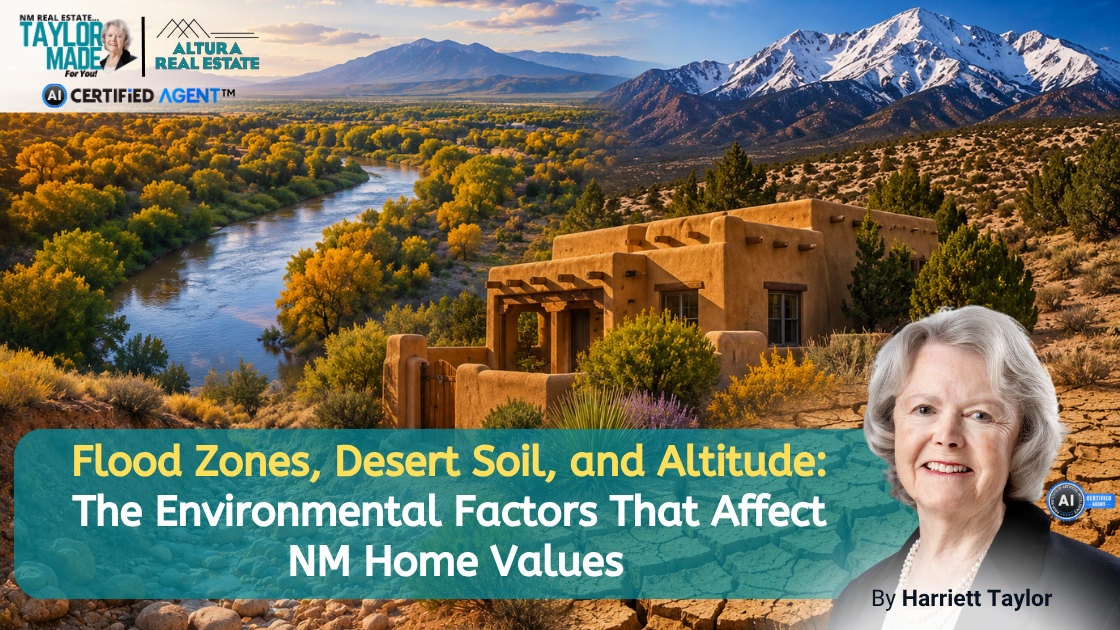
New Mexico is breathtaking — and that dramatic geography directly affects your home's value, insurability, and long-term appreciation. From the Rio Grande floodplain communities of Corrales and Bosque Farms to the high-altitude neighborhoods of Santa Fe and Taos, every piece of land in New Mexico tells an environmental story. Here's what buyers need to know before they sign.
1. Flood Zones: The Rio Grande and Beyond
FEMA flood zone designation is one of the most consequential labels a New Mexico p
roperty can carry. Homes in Zone AE (high-risk, 1% annual flood chance) require mandatory flood insurance for federally backed mortgages — adding $800–$3,000/year to your costs.
Communities with Notable Flood Risk
• Corrales & Bosque Farms: Large portions lie in Zone AE along the Rio Grande. The lifestyle premium (large lots, horse privileges, cottonwood bosque) is real — but so is the insurance cost. Always request an Elevation Certificate before purchase.
• Belen & South Valley (ABQ): River-adjacent parcels carry flood designations. Rio Communities, set farther east, has generally lower risk — but always verify individual parcel status.
• Albuquerque arroyos: The city's dry channels carry intense monsoon runoff with little warning. Ask your Realtor for AMAFCA (Albuquerque Metropolitan Arroyo Flood Control Authority) maps — these show arroyo setbacks not always reflected in FEMA data.
|
⚠ BUYER TIP: Look up any NM property at msc.fema.gov. Budget for flood insurance in Zone AE and always include an Elevation Certificate review in your due diligence. |
2. Desert Soil Conditions: What's Under the Ground Matters
New Mexico's soils create real structural risks that buyers often don't discover until after closing. Two types are most common:
• Caliche: A cemented calcium carbonate layer found 1–3 feet below the surface across much of central NM. It can impede drainage, complicate septic installation, and interfere with foundations — though it can also provide a stable base when properly engineered.
• Expansive clay: Common in Albuquerque's West Mesa, Rio Rancho, Valencia County, and especially the Estancia Valley (Moriarty). These soils expand when wet and shrink when dry, creating differential pressure that can crack slabs, stick doors, and separate walls. Foundation repairs range from $8,000–$40,000+.
Rural Soil Concerns: Septic & Water
For buyers in Rio Communities, Bosque Farms, East Mountains, or any community on well and septic — a soil percolation test is non-negotiable. Dense caliche or clay can fail a perc test, forcing expensive engineered septic systems ($20,000–$40,000) versus a standard system ($8,000–$15,000). Always confirm septic viability before purchasing rural land.
|
⚠ BUYER TIP: Request a home inspection that specifically assesses foundation movement. Look for stair-step cracks in brick, diagonal cracks at window corners, and uneven floors — all signs of expansive soil activity. |
3. Altitude: How Elevation Shapes Value and Livability
New Mexico's mean elevation of ~5,700 feet ranges from 3,100 ft (Carlsbad) to 7,199 ft (Santa Fe) to 13,000+ ft in the Sangre de Cristos. Elevation affects construction, energy costs, materials, and — in New Mexico's market — home values.
• UV intensity: Significantly stronger at altitude. Exterior paint, roofing, and composite materials degrade faster. Albuquerque homeowners should budget for repainting every 5–7 years versus 10–12 at sea level.
• Heating & HVAC: A Santa Fe home (7,199 ft) costs more to heat than a comparable Albuquerque home (5,312 ft). Natural gas appliances may need re-jetting at high altitude. Budget for whole-home humidifiers ($500–$2,000) in drier, higher communities.
• Snow load: Above 7,000 ft — Santa Fe, Taos, Angel Fire — roofs must meet higher structural load requirements. Flat-roofed adobe homes require vigilant snow removal.
• The altitude value premium: Santa Fe's elevation and lifestyle command the state's highest median home prices (~$680,000 in 2026). East Mountain communities (Tijeras, Edgewood, Cedar Crest at 6,500–7,000 ft) have seen 35–45% appreciation since 2020, driven by cooler summers and proximity to Albuquerque.
|
⚠ BUYER TIP: Relocating from sea level? Give yourself 4–8 weeks to fully acclimate to Santa Fe's elevation. Buyers with cardiovascular or respiratory conditions should consult a physician before committing to communities above 7,000 ft. |
4. Wildfire, Radon & Water Rights: Other Factors That Move the Needle
Wildfire Risk
The 2022 Hermits Peak/Calf Canyon Fire — New Mexico's largest on record — destroyed hundreds of homes and permanently tightened the insurance market in northern NM. Buyers in the WUI (Wildland-Urban Interface) near Santa Fe foothills, the East Mountains, Taos, and Mora County now face limited insurer options and premiums 2–3x above standard rates. Properties in moderate-to-high wildfire zones are seeing longer days on market and 5–15% discounts versus comparable lower-risk homes.
Radon
New Mexico has above-average radon levels due to uranium-bearing geology — particularly in the East Mountains, Grants area, and parts of Rio Arriba County. The EPA recommends action at 4 pCi/L. Mitigation costs $800–$2,500 and is highly effective. Always include a radon test in your inspection contingency.
Water Rights in Rural New Mexico
New Mexico follows prior appropriation water law — water rights are property rights, separate from land. For rural buyers in communities like Corrales, Bosque Farms, or the East Mountains, verify well logs, water quality, and that any irrigation or acequia rights are properly appurtenant to the land. A missing water right can dramatically reduce rural land value.
FAQ: Environmental Factors & NM Home Values
Do flood zones lower home values in New Mexico?
Yes, typically 5–15% versus comparable non-flood-zone homes. However, in communities like Corrales and Bosque Farms, lifestyle premiums (large lots, river access, equestrian use) often offset the discount. The real cost is ongoing flood insurance of $800–$3,000/year.
What is caliche and should I be worried about it?
Caliche is a cemented soil layer common throughout New Mexico. It can impede drainage and complicate septic systems but isn't always a structural problem. A proper home inspection and — for rural land — a soils report will tell you whether it affects your specific property.
Is it harder to get home insurance in New Mexico?
In wildfire-risk zones — particularly northern NM near Santa Fe foothills, East Mountains, and Taos — yes. Post-2022, several major insurers reduced or exited coverage in these areas. Albuquerque, Rio Rancho, Los Lunas, and Valencia County generally have normal insurance availability.
Do I need a radon test when buying a home in New Mexico?
Yes. New Mexico has higher-than-average radon levels in many areas. Testing is inexpensive, and mitigation (if needed) costs $800–$2,500. Always include it in your inspection contingency — especially in the East Mountains or any home with a basement.
Keep Exploring on search-newmexicohomes.com
• What $300K, $400K, $500K Buys You in New Mexico — Neighborhood-by-neighborhood breakdown
• New Mexico Population Growth & Real Estate Prices Through 2030 — Market trends by city
• What to Look for in a New Mexico Home (2026 Buyer Guide) — Climate, Construction, location and lifestyle
New Mexico's landscapes are part of why people fall in love with this state — but they're also financial realities that affect your mortgage, insurance, and long-term home value. The most common mistake buyers make is falling in love with a home without fully understanding the land it sits on. The right local Realtor makes all the difference.
|
Know Your Land Before You Close Flood zones, soil conditions, altitude, wildfire risk — Harriett Taylor uses AI-powered tools and hyper-local expertise to make sure you understand every environmental factor before you buy. Harriett Taylor – AI Certified Realtor® 📍 Los Lunas, NM AI-powered search. Hyper-local knowledge. Environmentally informed buying. |
© 2026 Harriett Taylor | Altura Real Estate. Environmental information is for educational purposes only. Consult licensed professionals for property-specific assessments.

Harriett Taylor
| Harriett Taylor | Altura Real Estate
or another way